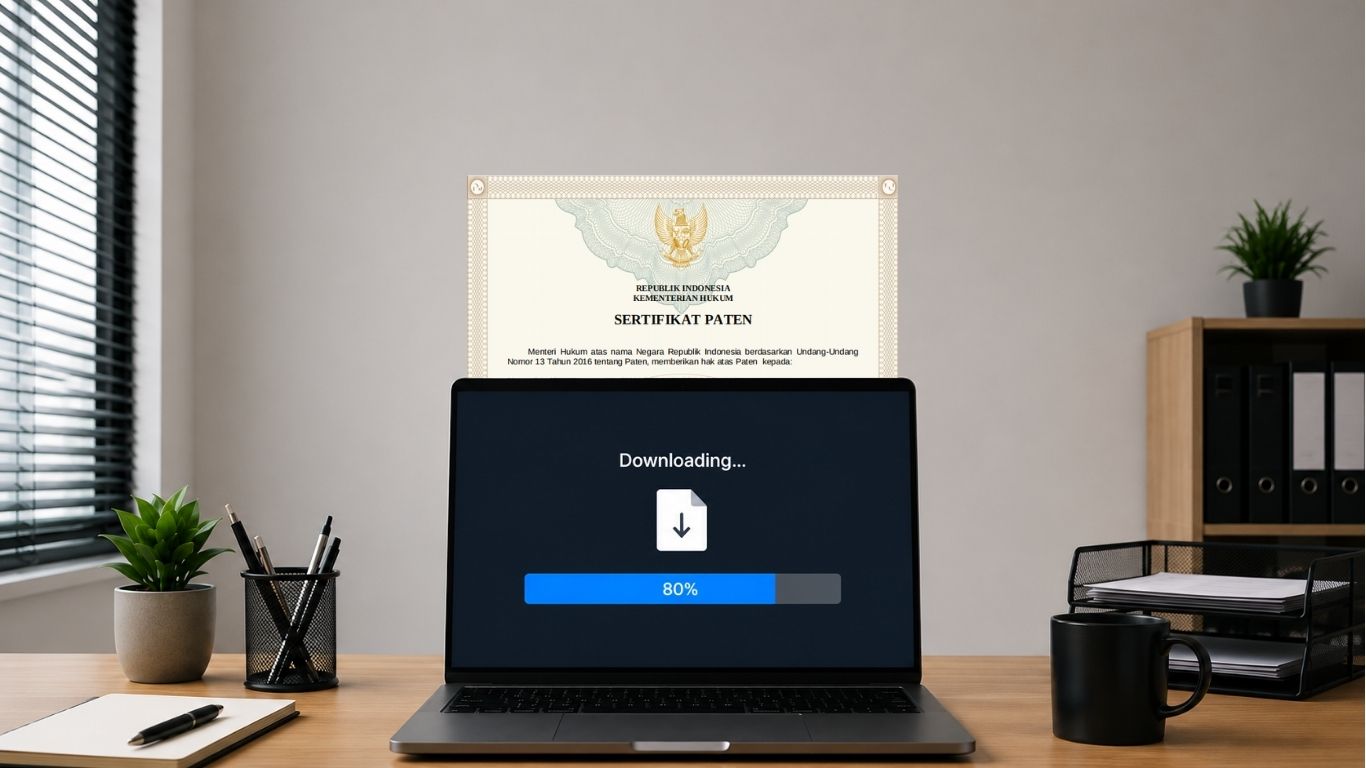
Government Accelerates the Digital Transformation of Patent Services
The Directorate General of Intellectual Property (DGIP) of the Ministry of Law continues to advance the digital transformation of Indonesia’s intellectual property services. One of the latest initiatives is the implementation of the Electronic Patent Certificate, as stipulated under Circular Letter No. HKI-14.KI.05.02 of 2026 on Electronic Patent Certificates.
This policy forms part of the Government’s broader efforts to enhance the efficiency, transparency, and accountability of public services in the field of intellectual property while supporting the operation of a fully online intellectual property administration system through the Intellectual Property Administration System (Sistem Administrasi Kekayaan Intelektual – SAKI).
Patent Certificates Are Now Issued Electronically
A Patent Certificate is an official document issued by the Minister of Law as evidence of ownership of a Patent or a Simple Patent. Previously, patent certificates were generally issued in physical (hard copy) form. However, in line with the ongoing digitalization of intellectual property services, patent certificates will now be issued electronically.
Pursuant to Circular Letter No. HKI-14.KI.05.02 of 2026, patent applications that are granted on or after 16 July 2026 will no longer receive a hard copy certificate. Instead, the Patent Certificate will be issued electronically (soft copy) through the Intellectual Property Administration System (SAKI).
Accordingly, the Electronic Patent Certificate serves as the official legal document evidencing ownership of patent rights and carries the same legal validity as proof of patent ownership.
Rationale Behind the Implementation of Electronic Patent Certificates
The implementation of Electronic Patent Certificates is intended to achieve several key objectives, including:
- enhancing the efficiency of public services in the field of intellectual property;
- expediting the issuance of Patent Certificates to applicants;
- providing greater legal certainty through certificates whose authenticity can be electronically verified;
- improving document security by minimizing the risk of loss or physical damage;
- promoting transparency and accountability in public administration; and
- supporting good governance through the digitalization of government services.
Furthermore, the issuance of Patent Certificates in electronic form constitutes an implementation of the prevailing laws and regulations governing electronically administered intellectual property services.
Downloading Electronic Patent Certificates
Under this new policy, the DGIP will no longer deliver physical Patent Certificates to applicants or registered Intellectual Property Consultants.
Instead, applicants and/or their appointed Intellectual Property Consultants are required to independently download and, where necessary, print the Electronic Patent Certificate through the Intellectual Property Administration System (SAKI) or the DGIP’s online service portal.
The DGIP has also issued detailed guidelines on the downloading and printing procedures for Electronic Patent Certificates, which form an integral part of the Circular Letter.
Legal Basis
The implementation of Electronic Patent Certificates is based, among others, on the following legal instruments:
- Law No. 13 of 2016 on Patents, as amended from time to time, most recently by Law No. 65 of 2024;
- Minister of Law Regulation No. 6 of 2025 concerning Patent Applications; and
- Circular Letter No. HKI-14.KI.05.02 of 2026 concerning Electronic Patent Certificates.
Key Considerations for Patent Applicants
Inventors, companies, research institutions, universities, and Intellectual Property Consultants should take note of the following:
- Patent applications granted on or after 16 July 2026 will receive Patent Certificates exclusively in electronic form.
- Ensure that your account in the Intellectual Property Administration System (SAKI) remains active and accessible for downloading the Electronic Patent Certificate.
- Retain the electronic certificate securely, as it constitutes the official legal evidence of patent ownership.
- Where required for administrative or evidentiary purposes, the Electronic Patent Certificate may be printed independently by the certificate holder.
Conclusion
The implementation of Electronic Patent Certificates marks another significant milestone in the modernization of Indonesia’s intellectual property administration system. This digital initiative is expected to improve service quality, streamline administrative procedures, and provide patent owners with faster, more secure, and readily verifiable proof of their patent rights.
For businesses, inventors, universities, research institutions, and other entities seeking patent protection in Indonesia, it is important to understand this procedural change to ensure a smooth post-grant administrative process. Assistance from qualified Intellectual Property Consultants can help ensure that every stage of the patent process from filing the application through obtaining and downloading the Electronic Patent Certificate is completed in full compliance with the applicable legal requirements.
Should you have any questions regarding the implementation of Electronic Patent Certificates, patent application procedures, intellectual property portfolio management, or any other intellectual property legal matters, please do not hesitate to contact our team.
For further information or to arrange a consultation with one of our intellectual property professionals, please visit the Contact page available on this website. We are committed to providing practical, strategic, and comprehensive legal assistance tailored to your intellectual property needs.
Author: Agus Susanto